 |
 |
 |
Gloiocladia laciniata
Blue Branching Seaweed
26 May 2025
Wickaninnish Bay, Vancouver Island, B.C., Canada
Tide: 0.1 foot low at 06:52 am PDT (measured at Tofino Tidal Station)
Weather: Mostly cloudy, wind SSE 10 to 15 km/hour, sea choppy, low westerly swell, humidity 76%, 13 ˚C.
Moon: New Moon (0 days); Next phase, New Moon, 8:02pm PDT; Previous Phase, Third Quarter, 20 May 2025 at 4:58am PDT.
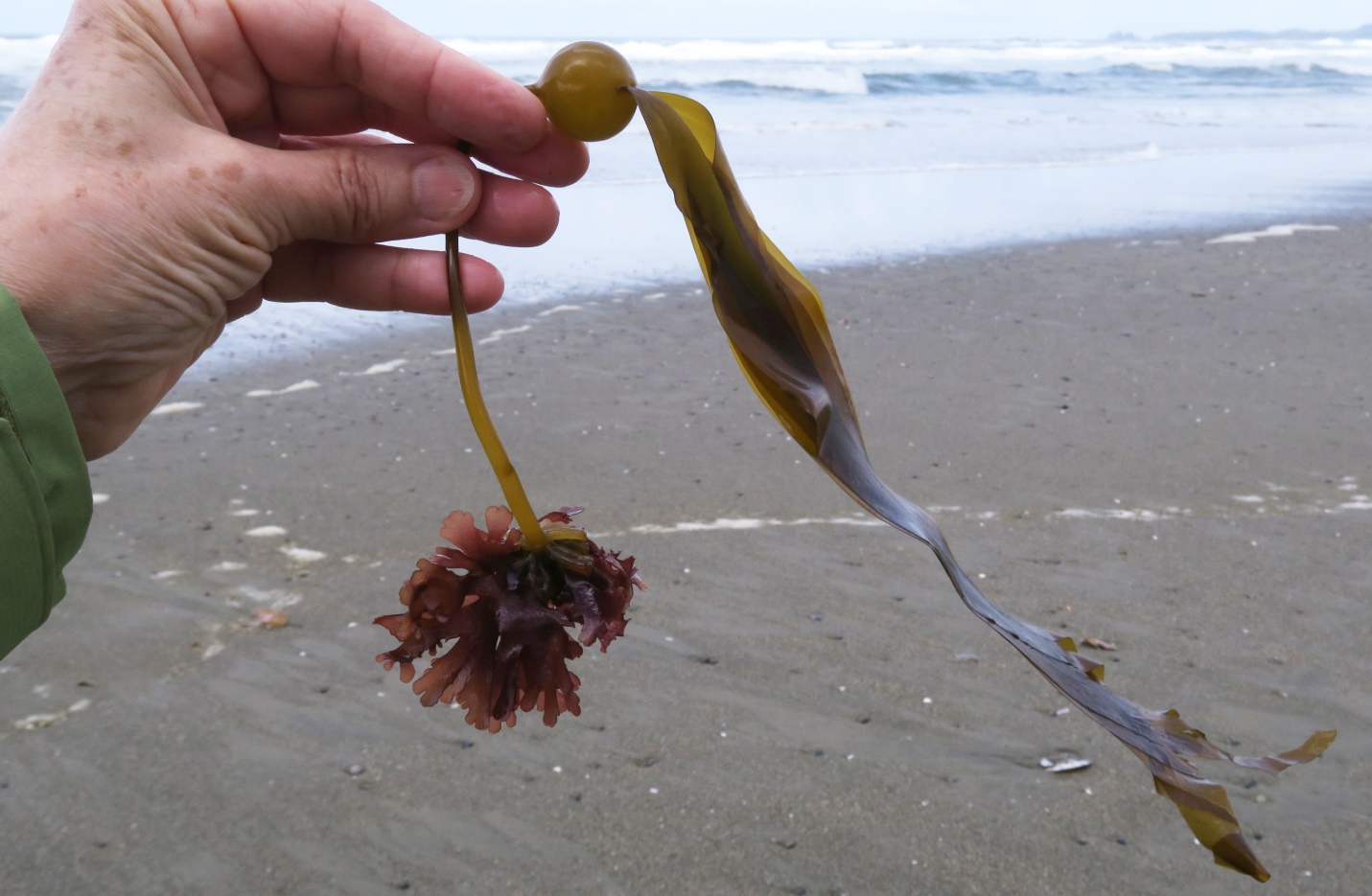
Figure 1: Walking the beach this day brought encounters with cast ashore seaweeds. This very young bull kelp, Nereocystis luetkeana, was dislodged from the substrate. Growing from the kelp’s holdfast ‘fingers’ (haptera) was an entirely different species – the red alga known as Gloiocladia laciniata. Gloiocladia, common name Blue Branching Seaweed, lives in the very low intertidal and subtidal depths; we have searched for it in the very low intertidal without success. It was life changing for these seaweeds but also fortuitous for our understanding of them that this pair were cast ashore here today. Wickaninnish Bay, Vancouver Island, B.C., Canada. May 26, 2025. Photo ID 27841 ©Seaweedwhisperings.com
Person 1:
Person 2 called me over to look at something she found on the beach; I couldn’t see what she was so excited about. “Couldn’t see the forest for the trees”. It was just another clump of epiphytic red algae. Thus, upon first consideration I couldn’t see anything special.
Gloiocladia likes to be associated with successful folk, but likes to be firmly attached in a safe place, out of the limelight.
Makes occasional forays to play with the light, but is ready to retreat at the slightest danger / challenge.
The shy or timid aspect of this seaweed is what I sensed first.
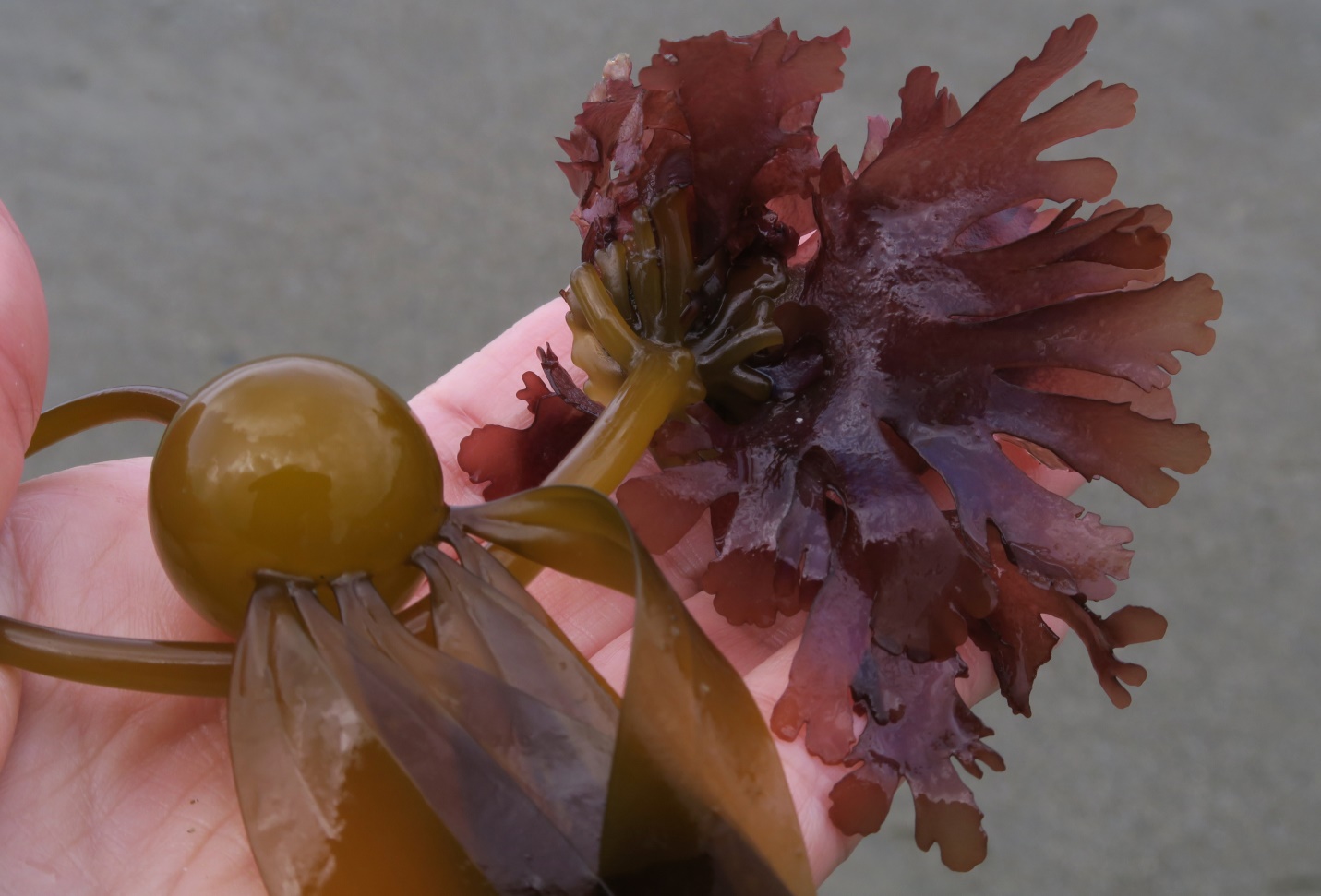
Figure 2: The young bull kelp’s stipe, float and blades can all be seen here. It hosts our seaweed of note, Gloiocladia laciniata, which has a deep red color that also has hints of blue within. Wickaninnish Bay, Vancouver Island, B.C., Canada. May 26, 2025. Photo ID 27842 ©Seaweedwhisperings.com
Person 2:
Encountering this seaweed was a remarkably fortunate thing, almost magical. Walking along Wickaninnish beach this day we found many bull kelp individuals washed ashore; they ranged greatly in age these kelp, and some of them were very young. At the holdfast of a young kelp I noticed a patch of rich red; it attracted my eye, and when I looked more closely I found a beautiful red alga living there.
The red of this seaweed caught my eye because it was somehow more than red; it had elements of violet blue to the hues also. Although the violet blue was not strong in this cast ashore individual, it was possible to sense its presence, almost as if all I had to do was go deeper in..., and hover within the wave lengths of light that this seaweed hosts.
There is iridescence involved here, and I find it interesting that I felt the need to “hover within” because in the bird kingdom hovering birds that have iridescent colors are the hummingbirds, and one of their special flight abilities is that they can hover.
Hover within, or between..., waves of light..., color will change and or be enriched.
There is a beauty to this kind of presentation of color that is admirable; indeed the violet blue tones have an almost magical quality to them. Yet this little seaweed feels as if it is anything but a showman. It is not theatrical and it doesn’t flash its qualities. Not at all.
First you have to have find Gloiocladia in the first place, and since it is primarily very low intertidal and mainly subtidal in its habitat this means spending quite a bit of time in the watery depths under the canopy of kelps and other seaweed. Then if you find it, the light must be somehow reaching exactly that spot, too. And even then, if you have all that going for you, you must look but not really focus..., the iridescence will show best when you hover in between the defined physical borders of this “blue” red alga. To do that you have to be willing to be a bit ‘lost’ or not quite anchored, or willing to let go of exact boundaries.
I wonder if for this seaweed, they are mastering this aspect for themselves? To be anchored and yet also wander between..., to work at things with no compass points for direction. To see but to do so by feel, or by sound, or by some other sense or combination of senses?
To do this well I think one has to be willing to play; to hover between boundaries and delight in sliding between realities in a game of hide and seek that is a delight for the imagination and oh so very rich for the senses. It seems that you almost can’t be an adult to take it in! Oh, there’s a bias..., that adults might be too attached to norms and rules to be able to engage in play and take in the delight! Perhaps what Gloiocladia is indicating is simply that any such biases limit the potential for ‘magic’.
For Gloiocladia laciniata perhaps one of their gifts is that they have a way of doing things that will look quite different from others; a way that observes different rules or is as yet undecided on which rules fit best for them.
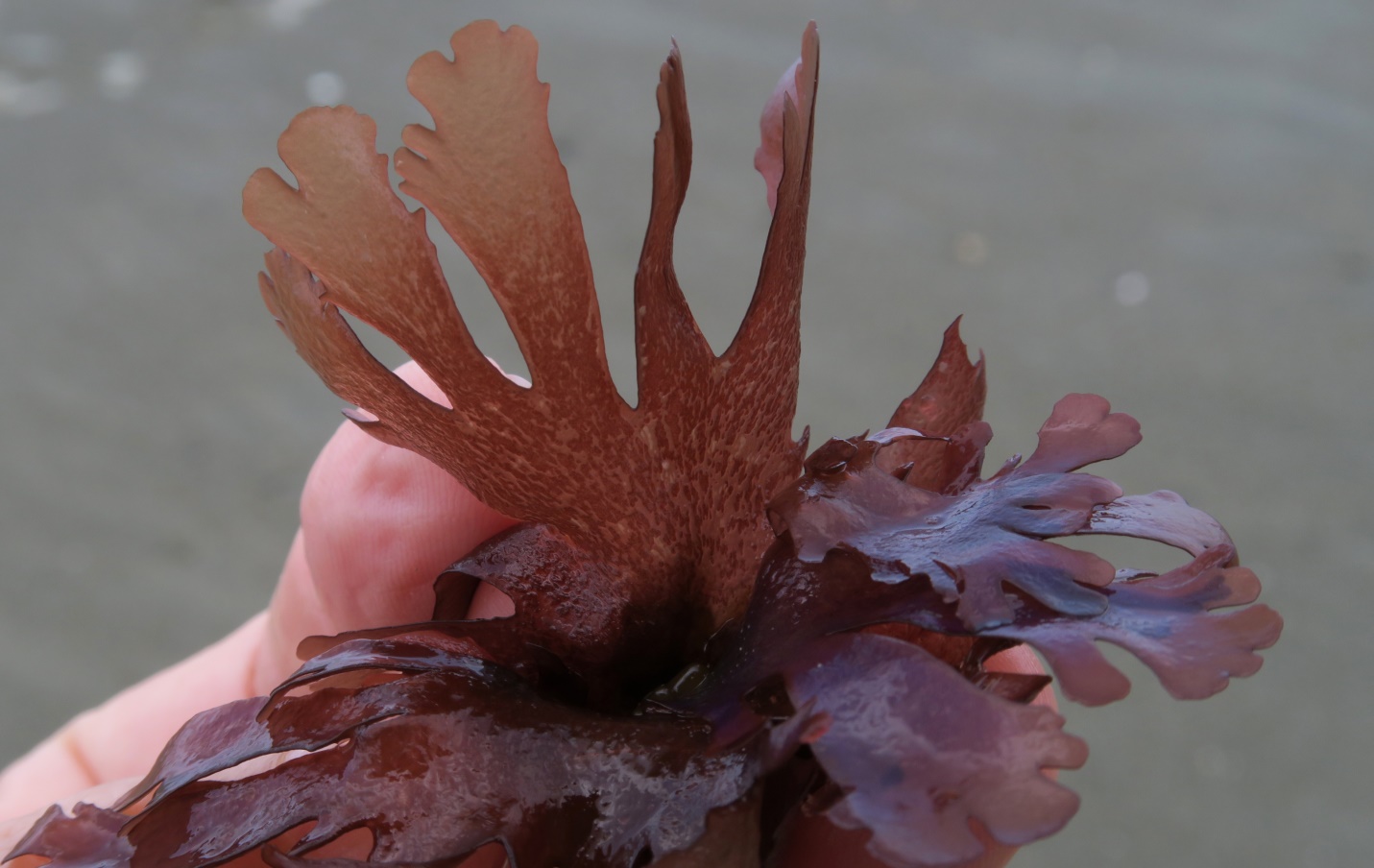
Figure 3: This photograph shows the tetrasporangial nemathecia, which are elongate in Gloiocladia laciniata. Tetrasporangia are a reproductive structure that produce tetraspores (haploid spores that develop into the haploid gametophyte generation of the species of alga) and they develop in slightly raised clusters of cells known as nemathecia. At first we wondered if this patterning we noticed was some form of decay since the alga was no longer in its habitat, but references including the Marine Algae of California directed us to identify this as being the tetrasporangial thallus. Wickaninnish Bay, Vancouver Island, B.C., Canada. May 26, 2025. Photo ID 27843 ©Seaweedwhisperings.com
Discussion:
Branching Blue Seaweed – there is something very special about the blue of this red alga. Something to the iridescence that fascinates or attracts attention. We felt that it is that the iridescence is surreal; surreal, unreal, almost imaginary. This is because as hard as you might try you really can’t quite grasp it, you can’t hold onto it. You look at it, and then if you change your angle of viewing, the iridescence is gone.
We noted that Gloiocladia “makes occasional forays to play with the light, but is ready to retreat at the slightest danger or challenge”. Going further with this concept and reviewing some of the photographs of this species made by other observers, we can see that especially when in situ with other duller algae, Gloiocladia laciniata does seem to be tucked away but it’s still obvious. What makes it stand out is its blue iridescence. Does this iridescence attract more attention than Gloiocladia wants to receive?
Because this iridescence does attracts others; there are many who try to photograph this small red alga compared to the many other species of small red alga. The iridescence is stunning and even different than the iridescence of other seaweeds we’ve seen such as with Mazzaella splendens. Those others catch our eye, but they don’t “draw us in” like Gloiocladia does; iridescence of that intensity is rather rare.
What happens when one is “drawn in” to an-other? Especially by such a stunning quality? It overwhelms..., and you basically suspend everything else. You focus on this one thing forgetting about everything else.
For the person who is drawn in this is an adventure of the senses. How does it feel for Gloiocladia? Gloiocladia is testing responses to see if there are benefits to presenting this image (the iridescence) and it felt that this is one way they could build self worth and identity..., via the admiration they feel from others. The problem in this is that the iridescence is not something that defines them to their core; it is a phenomenon that manifests on the superficial cuticle layers. So, possibly this tells us that it is difficult to know the ‘whole’ personality of Gloiocladia laciniata. Iridescence is a protection and a cover, however stunningly beautiful. Something like this can actually keep others away, being so very different. It can intimidate. Or possibly Gloiocladia is intimated when relating to others, and so chooses to do so with in this “cuticle-level” way.
Knows it is special, expects you to realize that. Meaning Gloiocladia is not going to do anything to prove itself, and the observer is supposed to know this. This can lead to misunderstanding due to unstated expectations. It can go the other way, too, where the observer is overwhelmed with wonder over their iridescence, but then finds that Gloiocladia has no awareness of how they possess such a phenomenal quality.
We felt that Gloiocladia has no real interest in others; this can be due to the fact that they are “lost” in whatever they are up to. Iridescence is reflected and refracted light. Being in the midst of that has a disorienting effect. There can be constantly changing perspectives, different tangents highlighted then quickly abandoned. The light is captivating but makes it difficult to settle in any one place, and there is little chance of understanding deeply because things change so quickly.
We pondered what the feeling for Gloiocladia in all of these amazing light effects, the reflected and refracted light. We found one feeling is dizziness. And this dizziness increases their desire to find their personal anchor point..., that association with “successful” folk, to have something known and comfortable that truly supports them.
There is a definite a shy or timid nature to this seaweed and that is in contrast to the flamboyant or somewhat ‘overdoing it’ attraction of its inherent iridescence. This is a notable contrast.
We could see persons with this energy getting enthralled with some of the ‘magical’ promises of certain spiritual concepts, self-improvement techniques, or even financial investment opportunities, but then also not truly getting anywhere with these efforts if they haven’t yet established their own base, their grounding.
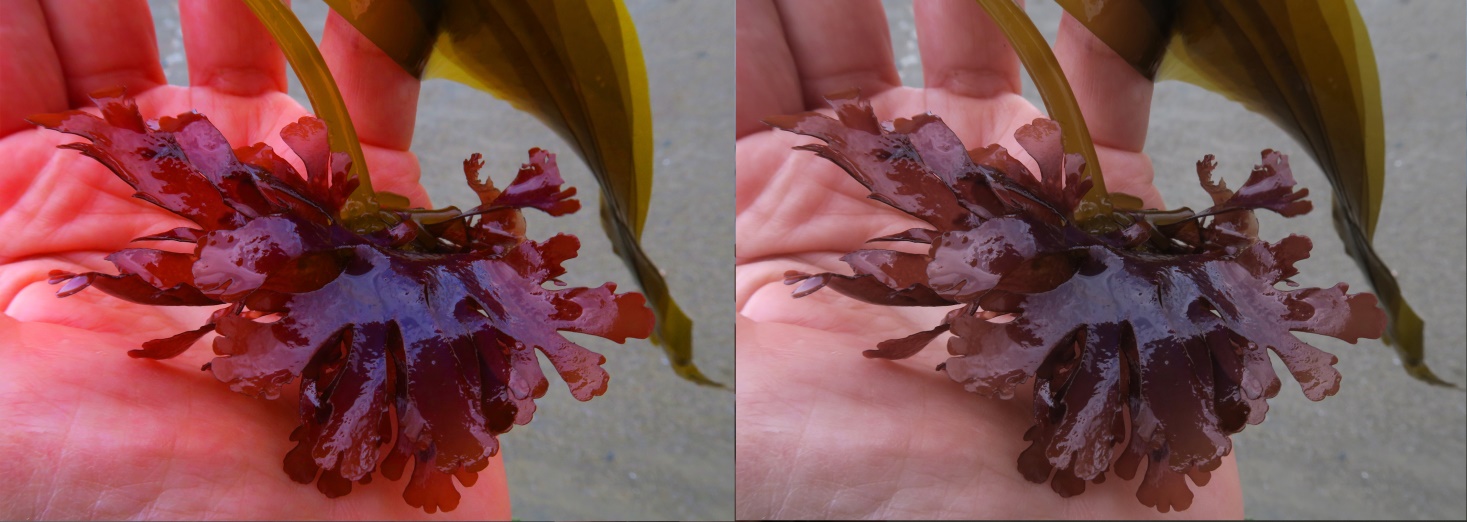
Figure 4: Adjusting the color saturation options on the right hand side image reveals some of the violet-blue hues that are only hinted at in same photo on the right (which is possibly a bit under-saturated but very close to how it looked on the beach this day). It is interesting that the violet or blue tones do somehow express themselves better to the human eye than to a camera, and it is also known that the blue tones are strongest when viewed underwater. With this still ‘wet’ but cast ashore specimen we didn’t have the advantage of an underwater view but it still retained a quality of that iridescence. To grasp this quality better, the interested reader is advised to look for more photographs on line, especially those taken by divers or with underwater equipment. Wickaninnish Bay, Vancouver Island, B.C., Canada. May 26, 2025. Photo ID 27844 ©Seaweedwhisperings.com
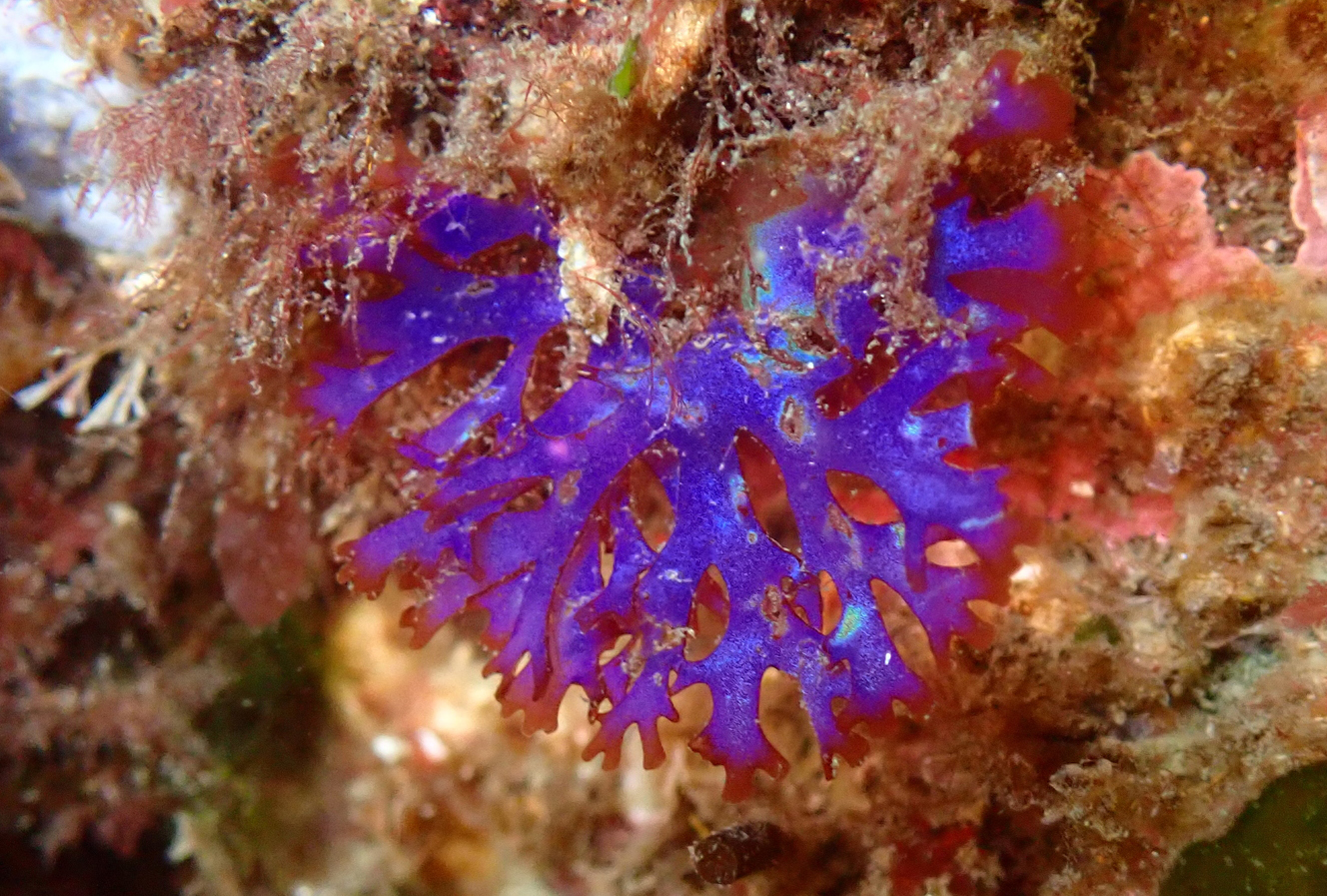
Figure 5: This is one example of the remarkable underwater photography that can be found on line; iNaturalist is a good starting point. Shown here is a cropped version of Karolle Wall’s excellent original image (Photo 149278944, © Karolle Wall, some rights reserved (CC BY-NC). Date and location: Boat Nook, Pender Island, B.C., Canada. July 22, 2021.
Biology & Natural History Information:
Description:
This striking red alga grows from 3 – 12 cm tall, forming loose clusters of fan-shaped blades that may be highly branched at apices. The blades are deep red in color with a bluish cast; underwater this blue can be seen as a bright iridescent blue-violet. The blades are slippery to the touch and more or less dichotomously branched into broad lobes. Cystocarps develop on the surfaces of the blades; they protrude above the surface and are textured with pointed knobs.
Habitat:
Occasional to frequent on rocks and other algae, very low intertidal and subtidal.
North Pacific Distribution:
Prince William Sound, Alaska to Baja California, Mexico.
Remarks:
The iridescence seen on blades of Gloiocladia laciniata is not related to any light producing phenomena (such as bioluminescence) but results from reflected and refracted light off a multi-layered cuticle.
Classification:
Empire: Eukaryota
Kingdom: Plantae
Subkingdom: Biliphyta
Infrakingdom: Rhodaria
Phylum: Rhodophyta
Subphylum: Eurhodophytina
Class: Florideophyceae
Subclass: Rhodymeniophycidae
Order: Rhodymeniales
Family: Faucheaceae
Genus: Gloiocladia
Species: Gloiocladia laciniata (J.Agardh) N.Sáncheze & Rodriguez-Príeto 2007
Former name(s):
Homotypic synonym: Fauchea laciniata J.Agardh 1885
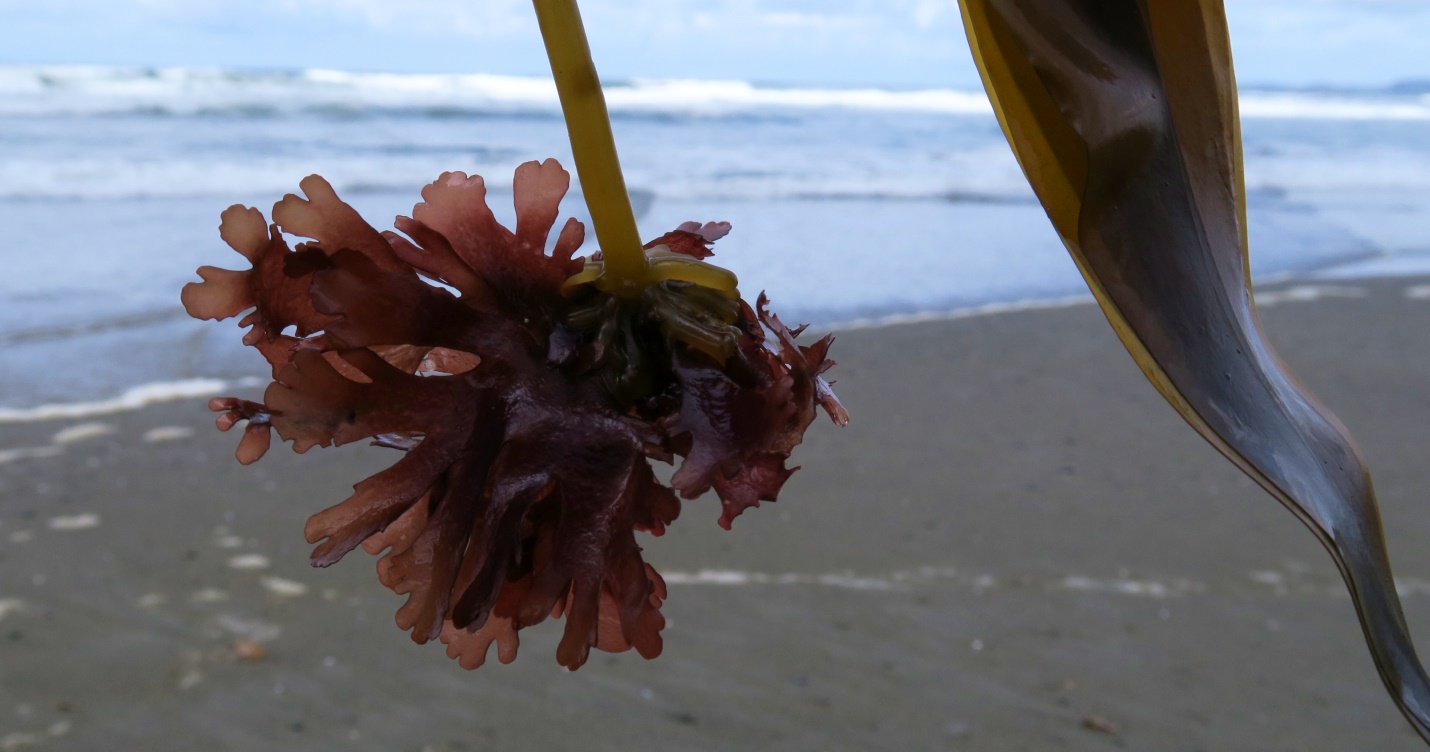
Figure 6: Another view of our Gloiocladia laciniata seaweed oriented as it would have been underwater at the base of the young bull kelp. Wickaninnish Bay, Vancouver Island, B.C., Canada. May 26, 2025. Photo ID 27845 ©Seaweedwhisperings.com
